Climate Innovation in Practice – Building Renovation and intelligent individual Room Control Technology
As part of Trane Technologies, AL‑KO Airtech leverages the collective strength and cross‑business synergies of the enterprise to bring sustainable solutions to market faster, more efficiently, and with greater impact.
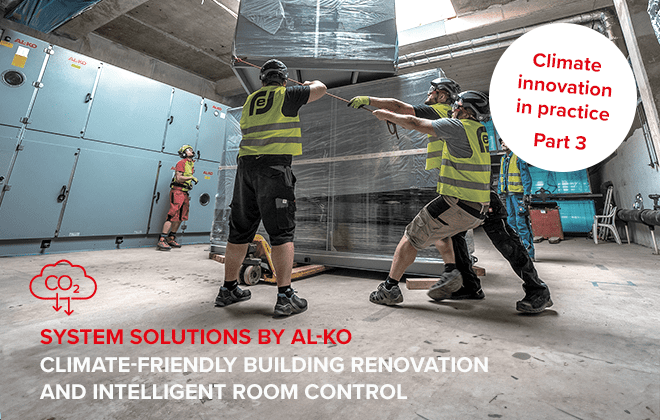
Renovating existing buildings as a contribution to climate protection
We support planners, municipalities, and building operators in implementing sustainable renovation strategies – with a clear commitment to reducing CO₂ emissions without compromising comfort. Custom‑engineered air‑handling units and HVAC systems, tailored for both existing buildings and new construction, enable the transition to climate‑neutral heating solutions and the use of low‑global‑warming‑potential refrigerants.
Intelligent individual room control technology – efficiency through demand assessment
A vital component of energy-efficient buildings is individual room control technology. Individual room controllers are considered a major lever for energy savings, because what counts is not only the AHU’s efficiency, but also smart demand control and air distribution. Ventilating only, when necessary, makes a decisive contribution to reducing energy consumption and operating costs. At the same time, factory-integrated control increases reliability, as the system and control are optimally coordinated. Sensors record the CO₂ content, temperature, and occupancy or utilization of a room in real time, and the air volume is adjusted as needed.
Anyone aiming to drive meaningful climate action in existing buildings must take a holistic approach – integrating technology, controls, and planning into one strategy.
In coming weeks, we will publish the final article of our four‑part series, Climate Innovation in Practice. Together we can achieve great things!
1 Official Journal of the European Union: https://eur-lex.europa.eu/legal-content/EN/TXT/?uri=CELEX:32024L1275